
Azure Blob Storage administration covers everything from the first storage account to access control, lifecycle rules and cost follow-up. Business IT Support configures and supports Blob Storage for businesses, remotely worldwide and on site in Sweden.
What Azure Blob Storage is and who needs it
Azure Blob Storage is Microsoft’s cloud storage for large amounts of files. Companies use it for backup, archives, images, logs and data that applications need to read. In addition, it works as a target for tools such as AzCopy and Azure Storage Explorer. The service scales from a few gigabytes to very large volumes, so it suits both small and large organisations.
Business IT Support configures, administers and supports storage accounts for businesses. First, we map what you want to store and how often you need to reach it. Then we choose structure, redundancy and access tier. As a result, you get a solution that protects your data and, at the same time, keeps the cost down.
Storage accounts and Azure Blob Storage administration
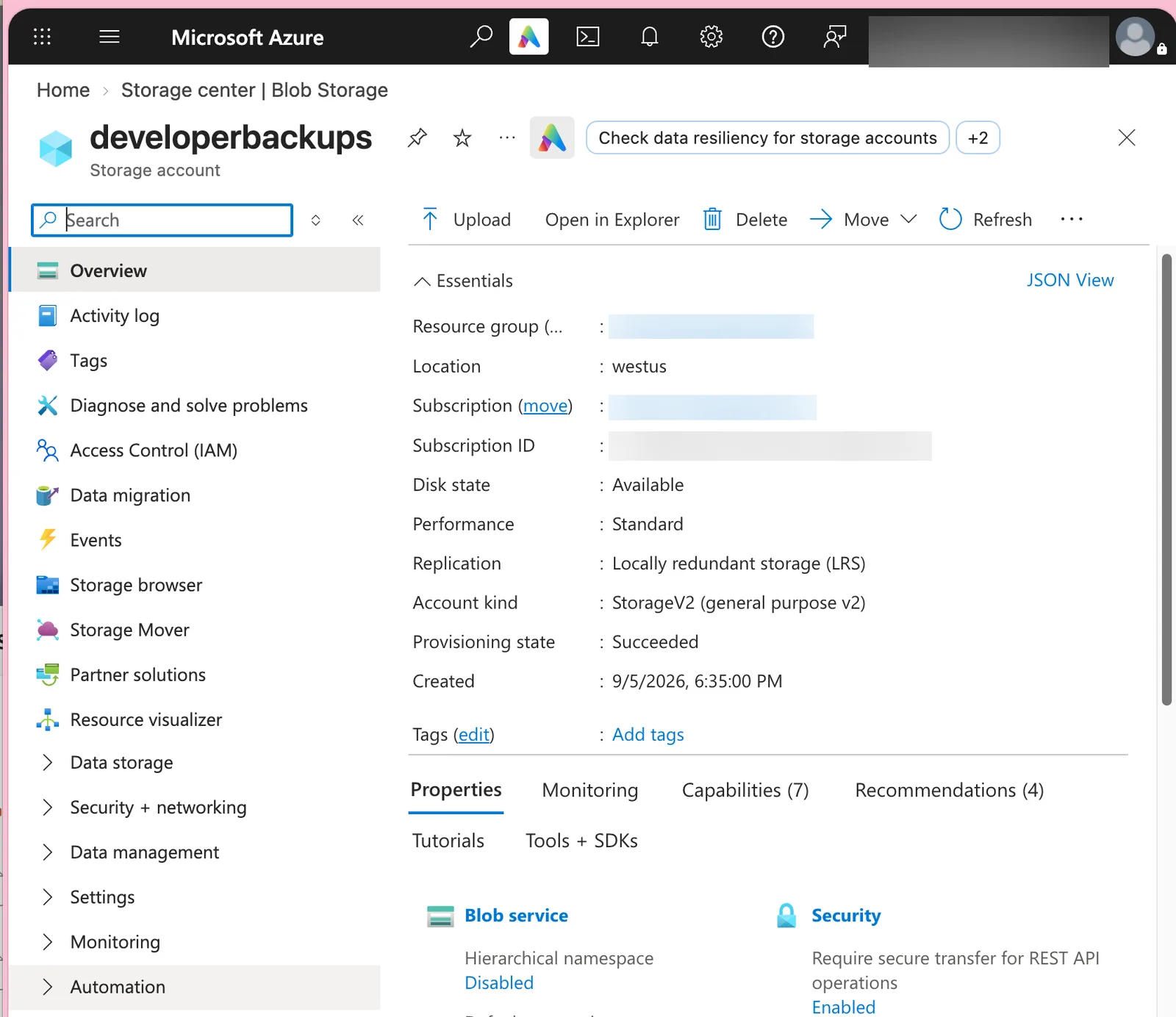
Everything starts with a storage account. When we create it, we choose subscription, resource group, region and redundancy, for example LRS for local copies or GRS for a copy in a second region. We also decide account type and performance. Furthermore, we turn off anonymous access straight away and require secure transfer for every request, so nobody can reach the data over an unencrypted connection.
Inside the account, we create containers that match the way you work. We also enable soft delete and versioning, so you can recover a file that someone deleted by mistake. In addition, we add tags for cost tracking and write a short description of the setup. Therefore, the next administrator quickly understands how the account works, and you never depend on one single person.
Access, permissions and network
Access is the most important security question. Whenever possible, we use Microsoft Entra ID and role-based access instead of account keys. For temporary access, we issue SAS tokens with a short lifetime and the smallest possible permissions. As a result, a leaked key cannot open everything, and audits become much easier.
We also limit network access. With firewall rules, private endpoints and service endpoints, only approved networks can reach the account. At the same time, we log every access, so you can see who read or wrote what. During an incident, the logs often decide how fast we find the cause. For that reason, we keep them as long as your requirements say and raise alerts on unusual patterns.
Access tiers, lifecycle rules and cost
First of all, three things drive the cost: the amount of data, the access tier and the number of transactions. Azure offers the hot, cool, cold and archive tiers, where warmer tiers cost more to store but less to read. Therefore, we move older data to cheaper tiers with lifecycle rules. We also delete temporary files automatically after a set period.
In addition, we follow up the cost in Azure Cost Management and set budget alerts. We also check that the redundancy matches the value of the data. For example, backups that nobody reads do not need the most expensive tier. Consequently, you get a predictable monthly cost that still meets your security requirements, and no surprises on the invoice.
Moving data, backup and restore
Moving data to Azure requires planning. We use AzCopy and Azure Storage Explorer for files, and we connect backup software directly to the account when possible. Before we start, we calculate how long the transfer takes over your internet connection. Large data sets therefore move in stages, and afterwards we verify every file and keep a report as proof.
Restoring data is just as important. For this reason, we test that files can come back, and we document each step. With immutable storage, we also protect backups against ransomware, because nobody can change or delete the files during a set period. Finally, we raise an alert if a backup does not arrive, so you discover the problem in time.
Ongoing support and troubleshooting
When something goes wrong, you need clear troubleshooting. Common problems include permission errors, blocked networks, expired SAS tokens and slow transfers. In those cases, we read the logs, check the roles and test the connection from your side. Then we fix the fault and explain the cause, so the problem does not return.
We also offer regular reviews of your storage accounts. During a review, we check access, cost, redundancy and logs, and you receive a short report. Moreover, we update the documentation as soon as anything changes. As a result, you feel confident, and it becomes easy to show an auditor or a customer how you protect your data.
Contact Datorkirurgen AB about Azure Blob Storage administration
Business IT Support is part of Datorkirurgen AB, which has more than 30 years of experience in IT for businesses. We configure, administer and support Azure Blob Storage for companies remotely anywhere, and on site in Stockholm and across Sweden.
Our prices start at €250 per hour excluding VAT, or as agreed, and we guarantee to solve the problem. Microsoft describes the service in its Blob Storage documentation. Contact us, and we will review your needs and suggest a solution.
Frequently asked questions about Azure Blob Storage administration
Azure Blob Storage administration basics
- What is Azure Blob Storage?
- What do companies use Blob Storage for?
- How do you create a storage account?
- What is a container?
- Which redundancy should we choose?
- What do LRS, ZRS and GRS mean?
- How much does Blob Storage cost?
- Which access tiers are available?
- How do you change the access tier of a file?
- What exactly is a blob?
Access and security in Blob Storage
- How do you give a user access to a storage account?
- What is the difference between an account key and a SAS token?
- How do you turn off anonymous access?
- Can we limit access to a specific network?
- What is a private endpoint?
- How do you log access to the storage account?
- How do you protect backups against ransomware?
- What is immutable storage?
- How do you enable soft delete?
- How often should we rotate account keys?
Migration, cost and support
- How do you move files to Azure?
- What is AzCopy?
- How long does a large transfer take?
- How do you check that every file arrived?
- How can we lower the storage cost?
- What is a lifecycle rule?
- Can we restore a deleted file?
- Why do I get a permission error?
- Can you handle the administration on an ongoing basis?
- How do I contact you about Azure Blob Storage administration?