
Agents for IT operations deliver the most value when every agent has one clear task. That is why Business IT Support, part of Datorkirurgen AB, has built an agent team in which six agents monitor, review and report for us every day. Below, we present them as animated humanoids and show exactly what each one does, how they work together and how much time they save.
Agents are today’s virtual robots
Car manufacturers build their vehicles with robots that weld, paint and inspect every detail with the same precision around the clock. Agents are the equivalent robots in the digital world. Instead of arms and tools, they have permissions, logs and programming interfaces, and instead of a car body, they work on servers, accounts, websites and backups.
Just like an industrial robot, an agent gets a clear role, a defined workstation and a check of every completed step. Therefore, we can give agents entirely different roles, for example guard, reviewer, detective or technician, and let them work together as a team. The agent can also combine fixed rules with AI models that sort and summarise large numbers of events, while decisions about changes always stay with a person.
Why an agent team instead of one large script?
A single large script that has to handle everything quickly becomes hard to test and risky to run. We therefore split the work into small agents, where each agent has one responsibility, its own permissions and its own report. As a result, we can improve one agent without touching the others, and a fault in one part does not stop the rest of the operation.
In addition, all agents follow the same three rules. First, the agent reads and reports, but it changes nothing on its own. Second, every change starts with a dry run and a backup. Finally, the agent logs everything it does, so that we can later see exactly what happened and when. You can find the basics in our article on agent development.
The certificate guard: agents for IT operations that never forget a date
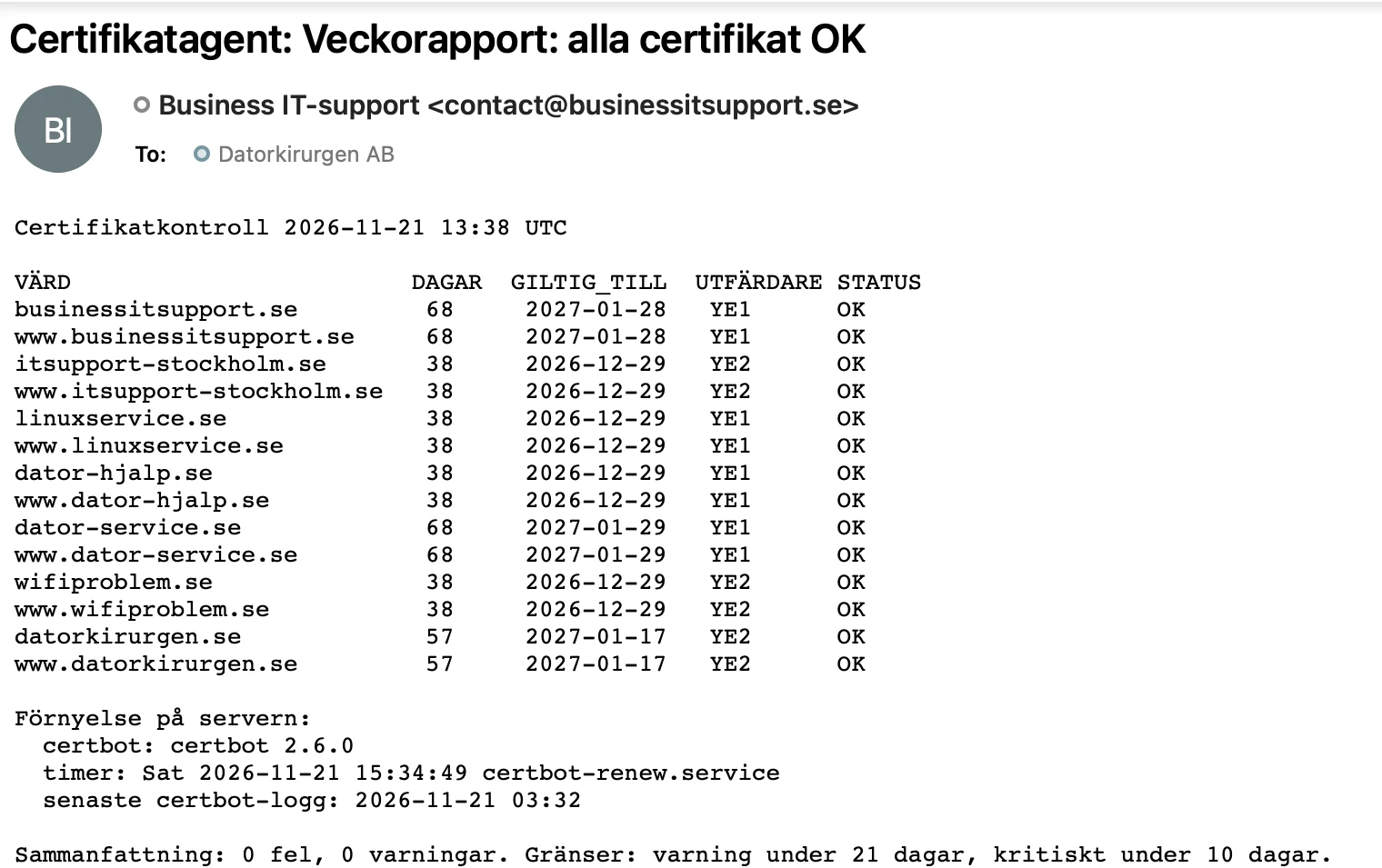
Every morning, the certificate guard checks the TLS certificates on all our websites, with and without www, 14 addresses in total. Using openssl, it checks how many days remain, that the certificate covers the right domain name and that the full chain verifies. At the same time, it confirms that certbot has an active timer on the server and that the latest renewal did not report an error.
The need will grow. Let’s Encrypt currently issues certificates that are valid for 90 days. However, the validity drops to 64 days in February 2027 and to 45 days in February 2028. Consequently, renewals become more frequent, and a missed date immediately shows a warning in the visitor’s browser. Our agent emails us when a certificate has fewer than 21 days left, and every Monday it sends a weekly report even when everything is fine.
The language reviewer and the image agent keep the quality high
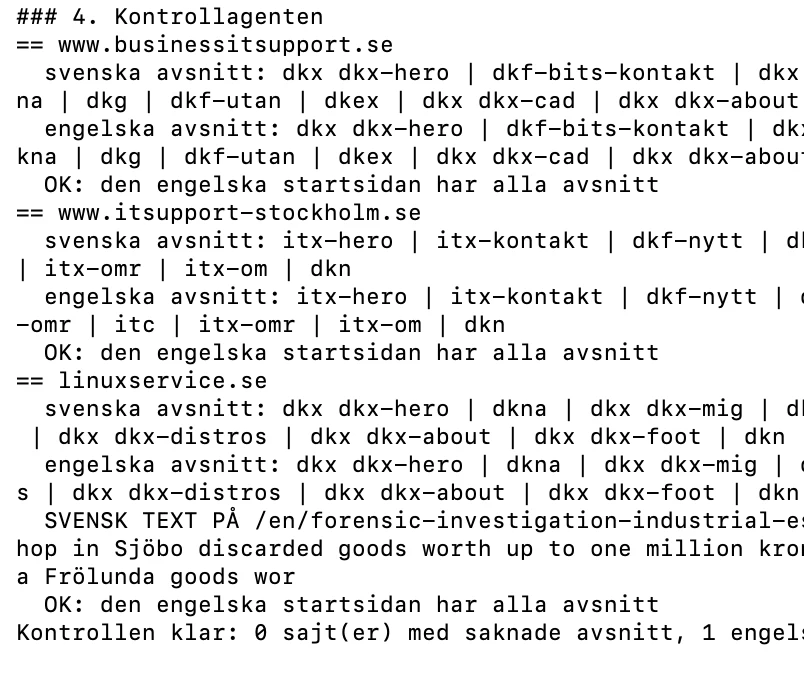
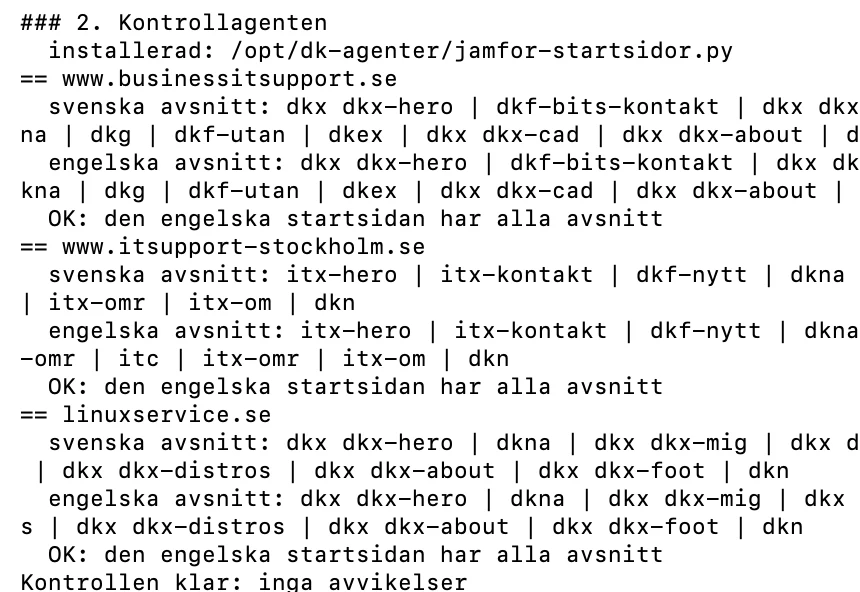
Our websites exist in Swedish and English. The language reviewer therefore compares each Swedish front page with the English one and checks that every section exists in both. Furthermore, it reads all English pages and looks for Swedish words with å, ä or ö that are not place names. On one occasion, for example, it found Swedish text in an English article, and we corrected it before any visitor noticed.
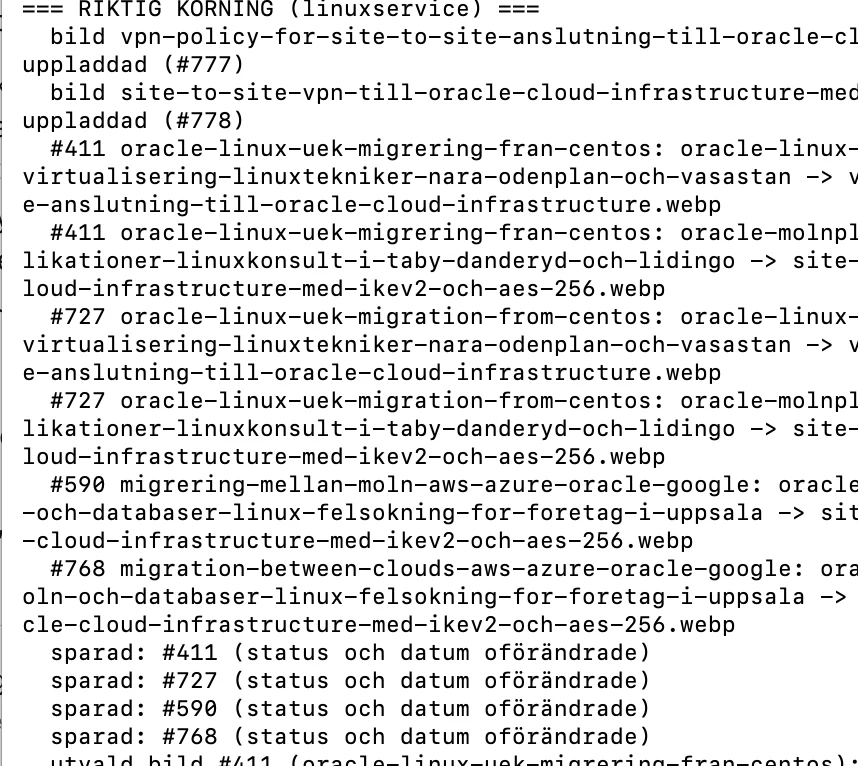
The image agent works the same way with images. It masks IP addresses and names in screenshots and gives each image a new file name for search engines. After that, it replaces the images in every language version and adds a 301 redirect from the old name. Finally, it checks that every page has a featured image and deletes only old images that no page shows any longer.
The narrator and the security detective
The narrator makes the articles accessible to readers who prefer to listen. It builds a script directly from the published page and creates audio with Azure Speech in a female and a male voice. While the text plays, it highlights each sentence and word. Because the agent stores a checksum for every track, it only creates new audio when the text has actually changed, which keeps the cost down.
The security detective, on the other hand, works on the servers. It reads logs with journalctl and auditd, flags repeated failed logins and new administrators and reports before anything changes. Linux Service, another part of Datorkirurgen AB, describes how we build this type of agent for Linux.
The maintenance agent and the coordination
The maintenance agent lists pending updates for WordPress, plugins and themes, takes a backup and runs a dry run. After that, it waits for explicit approval before it changes anything. In this way, maintenance becomes regular without anyone losing control of the production environment.
The agents start from systemd timers on the server instead of the WordPress scheduler, because that scheduler only runs when someone visits the site. Each agent writes a report to its own log folder, and a shared mail function sends only what needs action. Therefore, we receive a short message instead of hundreds of alerts, and the agents can run the same check any number of times without breaking anything.
Agents for IT operations in banking, industry and defence
The same principles work in sectors with high security requirements. In banking and finance, an agent can monitor logins to payment and transaction systems and detect unusual permission changes. It also raises an alert when an account signs in from a new country or at an unusual time. In industry, agents can instead monitor control systems and production networks, compare configurations against an approved baseline and raise an alert about unknown devices or changed programs. Linux Service describes how we protect control systems.
In the defence industry, the police and other authorities, traceability matters as much as the alert itself. There, we build agents that work in isolated networks, log every action in a tamper-proof way and only have read access. Likewise, agents can review access control systems, camera servers and alarm centres. A deviation in a security system then shows up as quickly as a fault in the IT environment. Datorkirurgen AB has experience from the defence industry and telecoms, and we adapt the agents to Swedish protective security law and your own security policy.
Hijacked accounts, unauthorised access and insider threats
Account takeover is one of the most common ways into a company today. An agent can therefore review sign-ins to Microsoft 365 and Entra ID every hour. It raises an alert on sign-ins from two countries within a short time and on repeated multi-factor prompts. Moreover, it flags new rules that forward email and apps that suddenly gain access to mailboxes. In the same way, the agent can detect intrusion attempts on servers, for example many failed logins or new administrator accounts.
Threats can also come from inside. An agent against insider threats and industrial espionage looks for patterns such as large downloads and unusual searches in drawing archives. Access outside working hours and copying to USB drives or private cloud services also stand out. The agent accuses no one; instead, it collects facts and reports to a responsible person, who then assesses the event. We describe what such threats look like in practice in our article on insider threats and industrial espionage.
Agents that monitor backups
A backup is only worth something if you can restore it. Even so, many companies discover during a ransomware attack that their backups stopped several weeks earlier. That is why we build backup agents that check all jobs every morning. They confirm that the size is reasonable compared with previous days and that the latest copy exists in a separate, write-protected location.
In addition, the agent can regularly restore a randomly selected file or database to a test environment and compare checksums. If the size suddenly changes sharply, or if many files get new extensions, the agent raises an alert at once, because that can be a sign that someone is encrypting data. Consequently, you hear about it while there is still time to act.
What agents for IT operations save in time and risk
The biggest gain is that the checks actually happen. A technician rarely has time to go through 14 certificates, two language versions of three websites and every image each week. The agents, however, do it every day in a few minutes. In our experience, hours of manual checking per week therefore turn into time for fixing what the agents find.
At the same time, the risk falls. An expired certificate, a Swedish sentence on an English page or an image with a visible IP address comes to light before customers or search engines see it. We are happy to build a similar agent team for your environment, whether it covers websites, Microsoft 365, Azure or your own servers.
Contact Datorkirurgen AB about agents for IT operations
Business IT Support is part of Datorkirurgen AB, with more than 30 years of experience in IT operations, security and systems development. We start by mapping which checks take the most time for you. Then we build one agent at a time, with a dry run, approval and logs from day one.
In addition, our prices start at €250 per hour excluding VAT, or as agreed, and we guarantee to solve the problem. Contact us via the form on our home page, and we will go through which agents will have the greatest effect in your environment.
Frequently asked questions about agents for IT operations
How do agents work?
- What is an AI agent?
- How does an agent work in IT?
- What is the difference between an agent and a script?
- Are agents the same as virtual robots?
- What roles can an agent have?
- Can several agents work together as a team?
- How do you develop your own agent?
- Which programming languages do you use to build agents?
- Can an agent combine AI with fixed rules?
- Can an agent replace an IT technician?
Agents for IT operations and security
- Can an agent detect intrusions in real time?
- How do you detect a hijacked account in Microsoft 365?
- Can agents raise alerts about unauthorised access?
- How do you find insider threats among your own employees?
- Can an agent protect against industrial espionage?
- How do you monitor backups automatically?
- Can banks and financial companies use agents?
- Do agents work with industrial control systems?
- Can the defence industry and authorities use agents?
- Can agents monitor access control and alarm systems?
Security, price and getting started
- Are AI agents safe to use?
- Can an agent change anything without our approval?
- Which permissions does an agent get?
- Where do the agents store their reports?
- How do you protect the agents against attackers?
- How much time does an agent team save?
- What does it cost to develop an agent?
- How long does it take to begin?
- Can you adapt the agents to our security policy?
- How do we contact Business IT Support about agents?